Newsletter Subscribe
Enter your email address below and subscribe to our newsletter
Enter your email address below and subscribe to our newsletter

 ByJohn A
Dialysis chairs are not waiting room furniture. A patient spends three to five hours in one, three times a week, often for years. That is not a comfort problem, it is a clinical one. And yet procurement teams across India still evaluate dialysis chairs the way they evaluate office chairs: price per unit, colour, and whether it looks presentable in a photograph.
Nephrologists see the consequences. Patients develop pressure points. Staff struggle to reposition someone mid-session. A chair that cannot recline properly turns a routine procedure into an endurance test. In these cases, the dialysis chair becomes part of the problem.
Here is what a proper specification checklist looks like, the kind that accounts for what actually happens inside a dialysis centre.
Blood pressure drops are one of the most common complications during haemodialysis, affecting roughly 20 to 30 per cent of sessions, according to data published by the Indian Journal of Nephrology. When that happens, a clinician needs to place the patient in the Trendelenburg position immediately, head lower than the feet, blood returning to the core.
If the chair cannot do that, the team improvises. Pillows, manual tilting, calling for help. Every extra minute matters. A dialysis chair with electronic Trendelenburg positioning removes that lag entirely. It is not a luxury specification. It is a clinical response tool.
Most vendors list motor count as a selling point without explaining what each motor controls. Here is a simple breakdown worth keeping in your checklist:
A chair with electronic height adjustment lets staff position the patient for vascular access without repeatedly bending over, which matters for needle placement accuracy and for reducing staff fatigue throughout a full shift. Backrest adjustment controls recline angle during the session. Leg rest and footrest adjustments improve lower limb circulation, which is a real concern in patients with peripheral vascular disease.
A chair with independent control over all four functions gives clinicians flexibility. One with a combined leg-rest-and-footrest mechanism offers less. The number of motors is a proxy for how many of these functions operate independently.
Perhaps this is the specification that is most often overlooked. In a cardiac emergency during dialysis, a patient needs to be laid flat for CPR in seconds. A chair with a standard reclining mechanism requires time and multiple steps to reach a flat position.
A quick-release backrest drops flat in one motion. That difference, a few seconds, is not trivial in a resuscitation scenario. The National Kidney Foundation’s clinical practice guidelines on haemodialysis adequacy flag patient safety systems as a design requirement for dialysis seating, not an afterthought. When reviewing chairs, ask the vendor to demonstrate the quick-release mechanism. If they have to think about it, that tells you something.
Dialysis patients are immunocompromised. The chair surface they sit on is cleaned between every session. Procurement teams tend to treat upholstery as an aesthetic decision; which material looks cleanest, which colour hides staining.
Clinically, the question is different. Does the surface withstand the concentration of disinfectant your team uses? Standard PVC upholstery degrades with repeated exposure to chlorine-based disinfectants. Cracked upholstery is not just a maintenance issue, it is a surface that cannot be fully disinfected. Dialysis chairs should specify disinfectant-resistant upholstery as a base requirement, not an upgrade.
Dialysis patients often have mobility limitations. Getting in and out of a chair that sits high off the floor is difficult and sometimes unsafe without staff assistance. A lower access height reduces transfer risk and allows more independent patient movement, thereby reducing the physical burden on nursing staff throughout a full session schedule.
This specification rarely appears in vendor brochures. Ask for the minimum seat height with the chair fully lowered. Compare it across options. It is a straightforward number that reflects real usability.
Some dialysis chairs come with programmable memory positions. A clinician can set the preferred positioning for a returning patient and recall it at the start of each session. For a centre managing 20 or 30 patients per day, that is time saved at every setup.
The mismatch between what procurement teams specify and what nephrologists actually need is not anyone’s fault exactly. Procurement managers are evaluating dozens of equipment categories at once. They work from quotes and catalogues, not from the floor of a dialysis unit.
The fix is straightforward: build the clinical checklist first, with input from the nephrology team, and let that drive the specification document. The chair that wins on price alone rarely wins on a five-year cost-of-ownership calculation once maintenance, replacement upholstery, and staff-time costs are factored in.
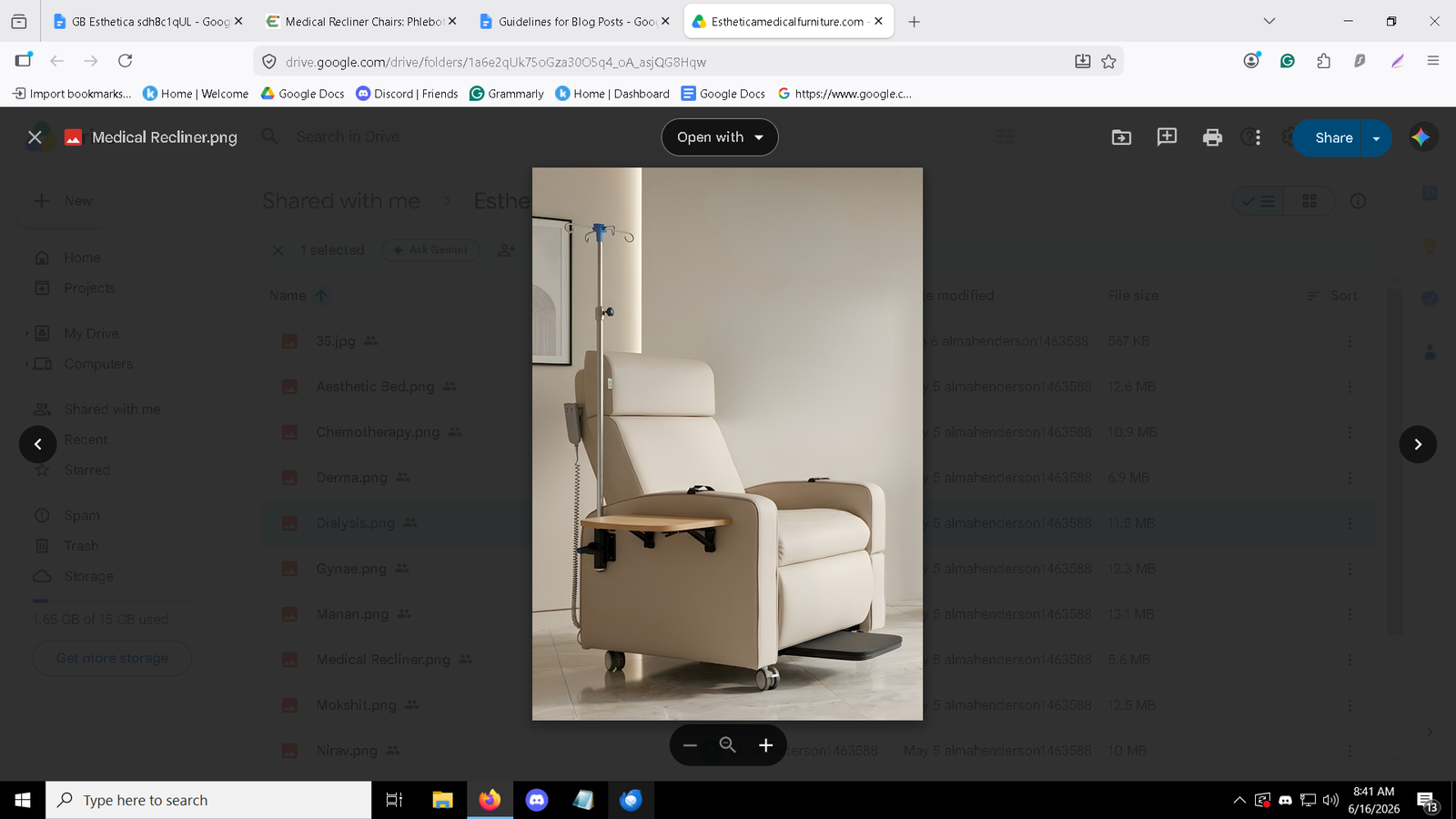
Esthetica Medical Furniture manufactures dialysis chairs with electronic Trendelenburg positioning, quick-release backrest systems, and disinfectant-resistant upholstery from its facility in IMT Manesar. The specification checklist above reflects the features built into their dialysis seating range.